

Table of Contents
- Why Authentic Luxury Decor Matters for Your Home
- Signs of High-End Furniture Quality to Look For
- How to Verify Luxury Home Decor Provenance
- Is High-End Furniture Worth It? Making the Investment Decision
- Digital Tools and AI Apps for Authenticating Luxury Decor
- Legal and Ethical Considerations When Buying Resale Luxury Decor
- Maintenance as Proof of Authenticity
- Frequently Asked Questions
Last Updated: September 17, 2026
Why Authentic Luxury Decor Matters for Your Home
Learning how to identify authentic luxury decor protects both your money and your home's long-term design. Genuine pieces hold their value, age gracefully, and bring lasting warmth to a space. Fakes fall apart quietly, often within a few years.
At Suemasue's Place, we curate furniture and décor built around natural materials and refined craftsmanship.
The stakes are real. The resale market for luxury goods keeps growing, and with it comes a rising tide of well-made counterfeits.
Below, we break down exactly what to inspect, where fakes give themselves away, and how to verify provenance before you pay.
Signs of High-End Furniture Quality to Look For
Real quality announces itself through joinery, materials, and finishing, not through a label. Run your hands along every edge. Your fingertips catch shortcuts that photos never show.
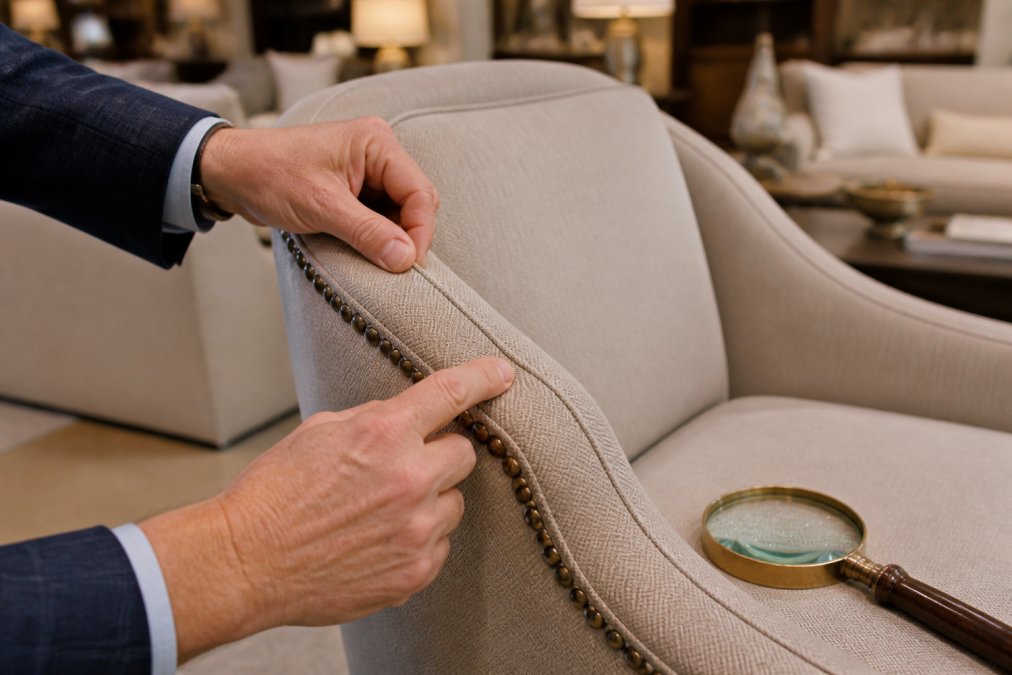
A common mistake is judging a piece by its surface alone. The real tells sit underneath and behind.
Joinery, Materials, and Finishing Details
Joinery is how a piece is held together, and it's the fastest authenticity test you can run. Look underneath tables and inside drawers.
- Dovetail or mortise-and-tenon joints: a strong sign of handcrafted work
- Staples, screws, and glue alone: usually mass production
- Sanded, sealed undersides: a maker who cared about hidden areas
- Rough, unsanded undersides: corners cut where you weren't meant to look
Materials should match the price. Solid hardwood feels dense and cool. Veneer over particleboard feels light and hollow when tapped.
Finishing separates good pieces from great ones. Even stain, tight seams, and smooth drawer glides all point to careful quality control.
Weight, Texture, and Hardware as Quality Clues
Weight is one of the hardest things to fake. Solid wood and stone carry heft. Hollow composites feel light for their size.
Texture tells you what you're actually touching. Real leather has natural grain and slight variation. Faux leather feels uniform and plastic-like. Genuine marble feels cool and shows unique veining.
Hardware is where fakes slip most often. Check for:
- Weight in the hand (solid brass feels heavy; plated zinc does not)
- Smooth engraving with clean edges
- Consistent font and logo alignment
- Screws that match the finish and sit flush
How to Verify Luxury Home Decor Provenance
Luxury home decor provenance verification means confirming where a piece came from and who made it. Provenance is the paper trail: receipts, tags, serial numbers, and maker marks that connect an object to its origin.
Without it, you're trusting a story. With it, you're trusting evidence.
Serial Numbers, Brand Tags, and Artisan Signatures
Start with the label. Brand tags on genuine pieces are stitched or fixed cleanly, with sharp printing and correct spelling. Crooked tags and blurry fonts are red flags.
Next, find the serial number or date code. On real pieces, it's stamped or engraved, never a peel-off sticker. Cross-check the number against the brand's own records when possible.
Then look for an artisan signature or maker's stamp. Many handcrafted pieces carry one. It's often small and easy to miss, so check the underside, the back, and inside drawers.
A simple verification checklist:
- Tag stitched or fixed cleanly, with sharp print
- Serial number stamped or engraved, not stickered
- Serial matches the brand's records
- Maker's stamp or signature present
- Logo font and alignment consistent with the brand
- Original receipt or certificate kept on file
Is High-End Furniture Worth It? Making the Investment Decision
High-end furniture is worth it when the piece will stay in your home for years and you value materials that age well. It's a poor fit if you plan to move soon or redesign often.
The math is simpler than it looks. A well-built sofa that lasts fifteen years usually costs less per year than three cheap ones that fail every five. Genuine materials also hold resale value, while mass-produced pieces rarely do.
Here's how the two compare:
| Factor | High-End Furniture | Mass-Produced Furniture |
|---|---|---|
| Joinery | Dovetail, mortise-and-tenon | Staples and glue |
| Materials | Solid wood, stone, real leather | Veneer, composite, faux |
| Lifespan | 10-20+ years | 3-7 years |
| Resale value | Holds much of its value | Little to none |
| Repairability | Can be refinished and repaired | Often replaced |
Digital Tools and AI Apps for Authenticating Luxury Decor
Digital authentication tools have moved from niche to mainstream, giving buyers a fast first filter before any in-person inspection. AI-powered apps can analyze a photo of a logo, stitching pattern, or hardware and compare it against large reference libraries of known authentic pieces. The result is a probability score, not a verdict, but it can flag obvious inconsistencies in seconds.
Here is how to use them effectively without over-relying on them:
- Scan the highest-risk details first. Logos, serial number fonts, and hardware engravings are where counterfeits most often fail. A clear, well-lit close-up photo is essential.
- Cross-check across multiple apps. No single app has perfect coverage. If two independent tools flag the same inconsistency, treat it as a strong signal.
- Verify serial number formats. Some apps include databases of known serial number patterns for major makers. A serial that does not match the expected format for the claimed brand and year is a red flag.
- Use AI as a triage tool, not a final judge. A positive scan does not guarantee authenticity. A negative scan does not always mean fake, especially for vintage or handmade pieces with natural variation.
For high-value pieces, digital checks should support, not replace, professional authentication. The two work best together: AI narrows the field, then a human expert with a loupe and reference samples confirms.
A common pattern among experienced buyers is to run a digital scan before requesting more photos from a seller. If the scan flags a problem, you save time. If it passes, you have a baseline to compare against the seller's claims.
Legal and Ethical Considerations When Buying Resale Luxury Decor
Buying resale luxury decor sits in a legal gray zone that most buyers never think about until something goes wrong. In many jurisdictions, including the United States and much of the European Union, unknowingly buying a counterfeit is not a crime for the buyer. However, reselling one, even unknowingly, can expose you to liability under trademark law. That distinction matters: you can be deceived and still face consequences if you later pass the item on.
The ethical side is just as important. Counterfeit goods often come from operations that undercut legitimate makers, sometimes using exploited labor and unsafe materials. Buying them, even by accident, supports that cycle. The secondary market for luxury decor is growing, and with it comes a rising tide of well-made fakes that blur the line between replica and real.
A few rules that protect you legally and ethically:
- Ask for the original receipt and any certificates. A seller who cannot produce paperwork for a high-value piece is a seller to approach with caution.
- Get the seller's claims in writing. Include the maker, date, materials, and any provenance details. Email or messaging app records count.
- Pay with a method that offers buyer protection. Credit cards and reputable escrow services give you recourse if the item turns out to be fake.
- Keep all documentation if you ever resell. Provenance paperwork is your legal shield if a piece turns out to be fake and you need to prove you bought it in good faith.
- Know your local laws. Some countries, like France and Italy, have stricter enforcement against counterfeit sales. If you buy internationally, understand the rules on both ends.
Maintenance as Proof of Authenticity
How a piece ages tells you almost as much as how it was made. Genuine materials develop character over time. Fakes degrade.
Real leather softens and darkens with use. Solid wood develops a warm patina. Marble shows fine surface wear that can be polished out. Faux materials crack, peel, or fade in patches instead.
This is why maintenance records matter.
Frequently Asked Questions
How can I authenticate my luxury items?
Start by checking for serial numbers, brand tags, and artisan signatures. Examine stitching, hardware weight, and material texture. For furniture, look at joinery and finishing. If uncertain, use digital authentication apps or consult professional authentication services. Keep all provenance documents.
How can I spot counterfeit luxury items?
Look for misaligned logos, inconsistent fonts, and lightweight hardware. Counterfeits often have uneven stitching, poor material drape, and missing serial numbers. Check brand norms online and compare details. If the price seems too low, it likely is. When in doubt, request provenance.
Is there a designer authentication app available?
Yes, several AI-powered apps can help verify luxury goods by analyzing logos, stitching patterns, and materials. They are useful for a first check but not foolproof. Combine app results with physical inspection and provenance documents for best accuracy.
How do I verify the provenance of luxury home decor?
Request original receipts, certificates of authenticity, and documentation of ownership history. For furniture, look for maker's marks, date codes, and serial numbers. Contact the brand or an authentication service to confirm. Provenance verification protects your investment and ensures authenticity.
Spotting authentic luxury decor comes down to slowing down and checking the details most buyers skip. Joinery, weight, hardware, and provenance paperwork tell the truth faster than any label. Suemasue's Place curates timeless furniture and décor built on natural materials and refined craftsmanship, so you can invest with confidence. Shop the Collection and bring enduring pieces into a home you truly love.