

Table of Contents
- What You'll Need Before You Start Styling Japandi Furniture
- The Japandi Color Palette: Neutrals, Earthy Tones, and Muted Accents
- How to Mix Wood Tones in Japandi Without It Looking Chaotic
- Choosing Low-Profile and Platform Furniture With Clean Lines
- Japandi Living Room Layout: Spatial Flow for Small and Large Homes
- Natural Materials, Textures, and Soft Lighting That Add Warmth
- Common Japandi Decor Mistakes to Avoid
- Conclusion: Build a Home That Feels Intentional
- Frequently Asked Questions
Last Updated: September 16, 2026
What You'll Need Before You Start Styling Japandi Furniture
Styling japandi furniture starts with subtraction, not addition. The aesthetic blends Japanese minimalism with Scandinavian warmth and rewards restraint: fewer pieces, better materials, more breathing room. This guide from Suemasue's Place covers the palette, wood mixing, layout, and lighting that separate a serene room from a showroom imitation.
Gather these first:
- A floor plan or room measurement. Note doorways, windows, and traffic paths in centimetres.
- A neutral base. Oat, sand brown, mushroom, or whitewash walls let low-profile furniture stand out.
- Two to three wood tones maximum. More reads as chaotic.
- Natural textiles. Linen, cotton, wool, and rattan in muted colours.
- One sculptural accent. A pedestal side table or stone lamp anchors a quiet room.
- A decluttering pass. Remove anything unused for a year before styling.
The Japandi Color Palette: Neutrals, Earthy Tones, and Muted Accents
The Japandi color palette is a narrow band of warm neutrals: oat, sand brown, mushroom, ash grey, and whitewash, lifted by earthy tones from clay, stone, and dried grass. Colour comes from materials, not paint.

Build the palette in three layers:
- Base (70%): walls, floors, and large upholstery in oat, whitewash, or soft grey.
- Mid-tone (20%): walnut, ash, or bamboo furniture and linen textiles.
- Accent (10%): a single muted tone such as charcoal, moss, or terracotta, used sparingly.
How to Mix Wood Tones in Japandi Without It Looking Chaotic
Mixing wood tones in Japandi works when you limit yourself to two or three species and repeat each at least twice. Repetition makes a mix look intentional rather than accidental.
A reliable approach:
- Pick a dominant tone such as walnut for the largest piece, usually the coffee table or dining table.
- Add a lighter secondary such as ash, oak, or bamboo for shelving or a side piece.
- Repeat each tone somewhere else in the room, even in a small object.
- Keep undertones consistent. Warm walnut sits badly beside cool grey-washed pine.
Choosing Low-Profile and Platform Furniture With Clean Lines
Low-profile and platform furniture is the backbone of a Japandi room: pieces sit close to the floor, silhouettes stay simple, and legs either disappear or become a deliberate sculptural feature.
What to look for:
- Seat heights around 40-45 cm for sofas and lounge chairs.
- Platform or pedestal bases rather than four thin legs.
- Rounded, organic shapes instead of sharp corners.
- Functional simplicity. Every piece should earn its footprint.
Japandi Living Room Layout: Spatial Flow for Small and Large Homes
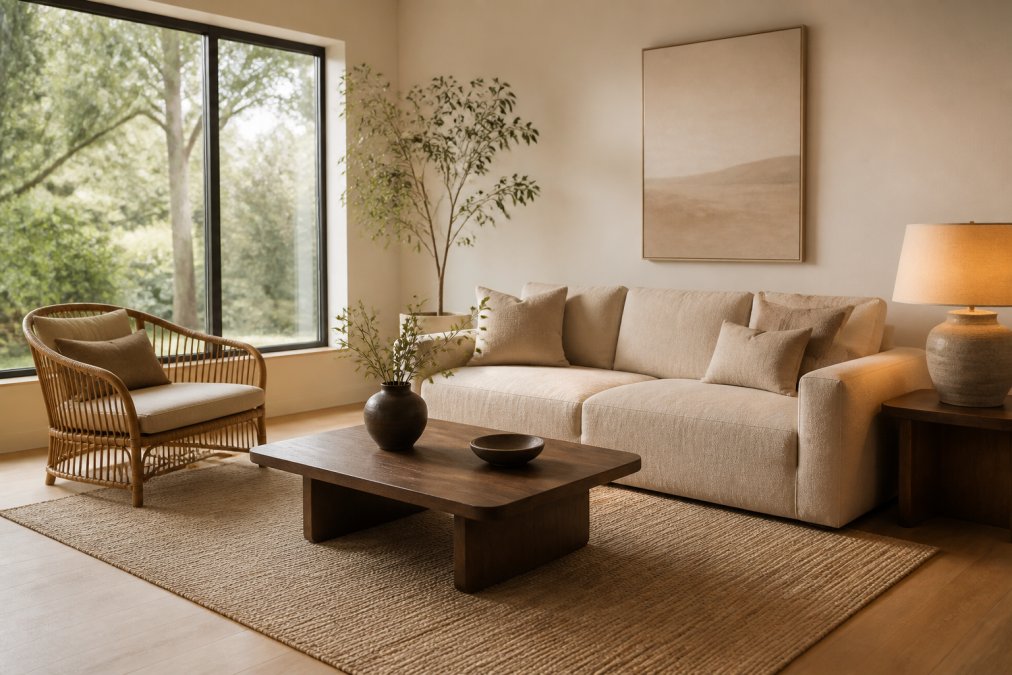
Japandi living room layout depends on one principle: leave the centre of the room open. Furniture hugs the perimeter, the middle stays clear, and the eye travels without interruption. The harder question is how to translate that into a floor plan when you have very little floor to give.
Start With a Measured Floor Plan, Not a Mood Board
Before moving furniture, sketch the room to scale, marking doorways, window sills, radiators, and door swing arcs, then mark your traffic paths. In many small homes the sofa, coffee table, and TV unit consume the only clear walking route, forcing a sideways shuffle no amount of linen and rattan can make calm.
A workable rule of thumb:
- Primary walkway: 75-90 cm wide. Below 75 cm, a path reads as an obstacle course.
- Secondary path (between sofa and coffee table): 40-45 cm. Enough to pass a mug, not enough to invite a second row of furniture.
- Sofa to wall (if floating): 60-80 cm where space allows, so light moves behind it. In a room under about 12 square metres, skip the float and push the sofa back, the lost walkway is worth more than the visual trick.
Small-Space Layouts That Actually Work
Three configurations cover most small apartments:
- The perimeter L. Sofa along the long wall, a single lounge chair on the adjacent wall angled inward, coffee table in the crook. Leaves the centre open and the window wall clear.
- The single anchor. One sofa facing the window, no second seating, plus a floor cushion or low stool that tucks under the coffee table. The most Japandi studio option because it refuses to fill the room.
- The dual-zone split. In a long narrow room, use a low console or rug edge, not a sofa back, to divide seating from sleeping or dining. Back-to-back sofas create a corridor, not a conversation.
What to Do With the Walls
Vertical space is the small-home Japandi secret. A low console with a single ceramic vessel, a floating ash shelf at eye level, or a tall narrow plant in a stone pot draws the eye up without eating floor. Keep window sightlines clear and hang curtains close to the ceiling to exaggerate height.
Natural Materials, Textures, and Soft Lighting That Add Warmth
Natural materials do the emotional work in a Japandi room. Wood, rattan, bamboo, linen, cotton, and stone bring warmth and texture a neutral palette alone cannot. But they also age, dry out, and stain in ways synthetics do not, so if you invest in real materials, you need to keep them looking intentional rather than tired.
Wabi-Sabi Travertine Pedestal Side →
Layer them deliberately:
- Wood for structure and warmth.
- Rattan or bamboo for lightness and a handcrafted feel.
- Linen and cotton for softness on sofas, cushions, and curtains.
- Stone or travertine for weight and a weathered texture.
Caring for Wood Without Stripping Its Character
Solid wood in a Japandi room is usually oiled or soaped, not lacquered, so it can breathe and patina, and that finish needs feeding. Re-oil once or twice a year in dry climates, once every twelve to eighteen months in humid ones. Use a hardwax or furniture oil matched to the species, applied thinly with a lint-free cloth, left to absorb, then buffed.
Rattan, Bamboo, and Cane
Rattan and cane are flexible when humid and brittle when dry, which is why they crack in centrally heated apartments. Dust with a soft brush or vacuum brush attachment rather than a wet cloth, which can lift the weave and leave water marks. If the weave feels stiff, a light mist of water, not a soak, restores pliability. Keep rattan out of direct sun; UV bleaches it unevenly and accelerates brittleness.
Linen, Cotton, and Wool
Linen and cotton are the workhorses of Japandi soft furnishing, and they are meant to crease, resist ironing everything flat, since the relaxed texture is part of the look. Wash linen cool and air-dry where possible; high tumble drying stiffens it and shortens its life. Rotate cushions and throws so fading stays even, especially near windows. Wool rugs need a weekly low-suction vacuum and a professional clean every couple of years; rotate the rug 180 degrees every six months so traffic wear stays balanced.
Stone and Travertine
Travertine and other porous stones are beautiful and unforgiving: they stain. Seal them on arrival if the manufacturer has not, and reseal every one to two years depending on use. Wipe with a dry or barely damp cloth, never wet, and avoid acidic cleaners, which etch the surface. A coaster under a stone side table is unnecessary; a coaster on top of it is not.
Soft Lighting Completes the Picture
A stone table lamp with warm ambient illumination creates the low, even glow that defines hygge and wabi-sabi spaces. Skip overhead downlights at full brightness; use two or three warm sources at different heights, a floor lamp, a table lamp, a candle or two. Bulbs in the 2200-2700K range read warm without tipping into orange. Dimming matters more than brightness: dropping the room to a low evening glow makes it feel calm rather than merely lit.

Common Japandi Decor Mistakes to Avoid
The most frequent Japandi decor mistakes come from over-styling. This aesthetic is defined by what you leave out, and almost every error is an addition.
Watch for these:
- Too many wood tones. Stick to two or three and repeat them.
- Matching sets. A full matching suite reads as curated and flat. Mix pieces from different sources.
- Clutter on surfaces. One object per surface is usually enough.
- Cool grey everything. Japandi needs warmth; cold grey reads as Scandinavian-only.
- Bright accent colours. Keep accents muted and rare.
- Ignoring acoustics. Hard floors and bare walls echo. Add a wool rug, linen curtains, or an upholstered chair to soften the room.
Conclusion: Build a Home That Feels Intentional
Styling japandi furniture is a slow exercise in deciding what to leave out: start with the palette, limit wood tones, keep furniture low and functional, and let natural materials and soft lighting carry the warmth.
Frequently Asked Questions
What are common Japandi decor mistakes to avoid?
The biggest mistake is treating Japandi as pure minimalism and stripping all warmth from a room. Japandi furniture needs texture: linen, rattan, raw wood, and stone. Another common error is mixing too many competing wood tones without a dominant base. Choose one primary wood, then add one or two accent tones. Clutter is the third trap. Every object should earn its place, whether it is a sculptural side table or a single ceramic vase.
What color palettes work best with Japandi furniture?
Stick to a neutral palette of ash grey, mushroom, oat, and sand brown, with whitewash or off-white walls as the backdrop. Earthy tones like muted terracotta or soft olive work as accents but should stay under ten percent of the room. The goal is a serene, muted base that lets natural materials and wood grain stand out rather than compete.
How do you balance Japanese and Scandinavian elements in furniture styling?
Japanese minimalism brings restraint, low-profile silhouettes, and wabi-sabi imperfection. Scandinavian influence adds hygge, functional storage, and softer textiles. Balance them by choosing furniture with clean lines but warm finishes, such as a walnut coffee table with rounded edges. Pair it with a chunky linen throw and a handcrafted ceramic bowl. The mix should feel intentional, not themed.
Is Japandi style still trending in 2026?
Yes. Japandi has moved from a trend into a lasting design language because it aligns with intentional living and sustainable choices. Design-conscious homeowners and interior designers continue to specify natural materials, low-profile platform furniture, and clutter-free layouts. Its focus on craftsmanship and timeless forms means pieces stay relevant for years, not seasons, which is why it endures.