

Table of Contents
- Why Mixing Luxury Furniture With Vintage Works
- Best Practices for Mixing Design Styles
- How to Style Vintage Furniture in Modern Homes
- Balancing Antique and Contemporary Furniture
- Budget-Conscious Sourcing for Mixed-Era Collections
- Maintenance and Care for Mixed-Era Collections
- The Sustainable Advantage of Mixing Luxury Furniture With Vintage
- Frequently Asked Questions
Last Updated: September 25, 2026
Why Mixing Luxury Furniture With Vintage Works
Mixing luxury furniture with vintage means pairing high-end contemporary pieces with older, character-rich finds so each makes the other look better. Done well, it creates rooms that feel collected rather than ordered from a single catalogue.
The reason it works is contrast. A clean-lined luxury furniture piece gives an ornate antique room somewhere to rest the eye, while a worn vintage table stops a modern room from feeling like a showroom.
The goal isn't "old plus new", it's balance. Too much vintage reads as a museum; too much new reads as a hotel lobby.
So how do you get it right?
The 80/20 Rule of Decorating
The 80/20 rule means roughly 80% of a room shares a common thread, color, material, or mood, with 20% breaking from it.
- 80%: consistent palette, materials, or silhouette
- 20%: the vintage find, the statement piece, the odd shape
Best Practices for Mixing Design Styles
The best way to mix design styles is to connect them through a shared element, then let everything else differ, that connector keeps an eclectic room from looking accidental.
Three connectors work reliably:
- Color: repeat one tone across eras
- Material: carry wood, stone, or metal through the room
- Shape: echo a curve or a line in different pieces
Choosing a Unifying Color Palette
A unifying color palette is a small set of tones used across every era in the room. Two or three colors is plenty.
Keep it simple:
- One dominant neutral
- One secondary tone
- One accent, used sparingly
Balancing Scale and Proportion
Balancing scale and proportion means matching the size and visual weight of pieces to each other and the room. A heavy antique next to a delicate modern chair works only if the contrast is intentional.
- Anchor: the largest or heaviest piece
- Support: mid-size pieces that echo it
- Accent: small pieces that add contrast
How to Style Vintage Furniture in Modern Homes
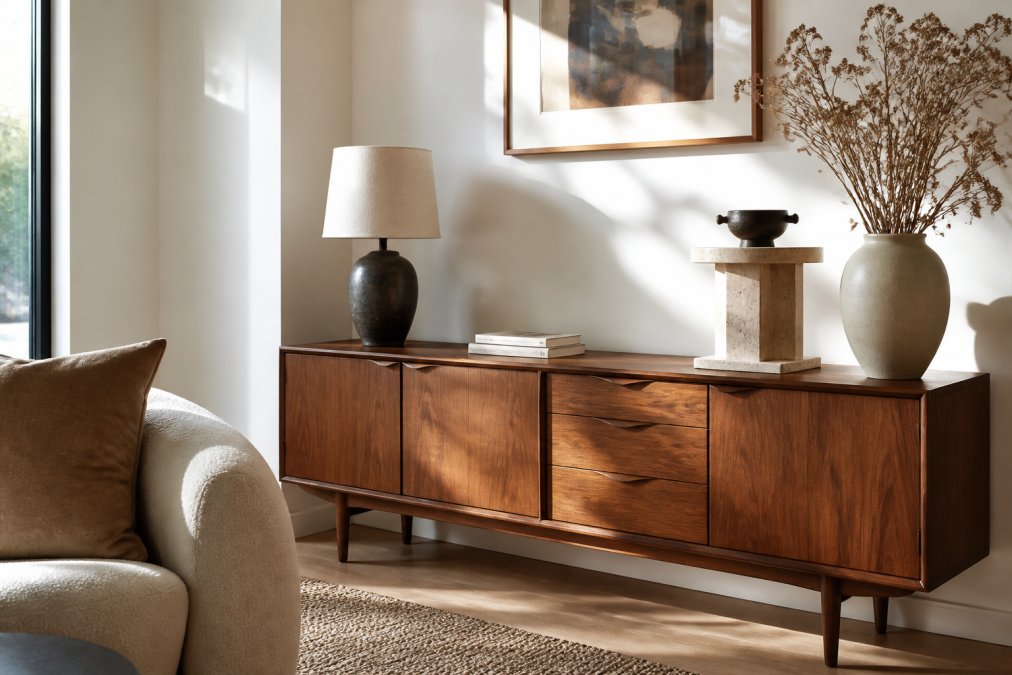
To style vintage furniture in a modern home, give the old piece room to breathe and let modern pieces frame it. Crowding a vintage find with more vintage is the fastest way to make it look tired.
A Room-by-Room Styling Method
Most guides stop at "leave negative space." Here's the practical method that actually works, room by room.
The Three-Item Rule
When in doubt, style in threes: one vintage piece, one modern piece, one neutral bridge (a plant, a lamp, a textile). This keeps the eye moving and prevents either era from dominating.
Try these moves:
- Leave negative space around the vintage piece
- Pair it with one modern item, not three
- Keep the surrounding palette quiet
- Vary height across the trio, low, mid, tall
- Repeat one material (wood, stone, metal) across all three
What to Avoid
- Don't cluster multiple vintage pieces in one sightline, it reads as a collection, not a design
- Don't match wood finishes exactly; slight variation looks intentional, exact matching looks like a set
- Don't place vintage pieces in high-traffic pinch points where they'll get bumped
- Don't light a vintage piece with a harsh overhead fixture, use a table lamp or picture light to bring out patina
Balancing Antique and Contemporary Furniture
Balancing antique and contemporary furniture comes down to one question: which piece is the focal point? Every room needs one. If two pieces compete, neither wins.
How to Read Visual Weight
Visual weight makes balancing work in practice: two pieces can be the same size and still feel wildly unequal. Weight comes from four things:
- Mass: a heavy carved oak armoire outweighs a slim glass console of the same height
- Contrast: a dark piece against a light wall reads heavier than a light piece against a dark wall
- Detail: ornate carving, inlay, or pattern adds weight; clean lines subtract it
- Color saturation: a saturated vintage rug pulls more weight than a pale modern one of the same size
The Focal Point Decision
A helpful guide:
| Room Goal | Focal Point | Supporting Pieces |
|---|---|---|
| Calm, pared-back | Contemporary piece | Vintage accents |
| Collected, layered | Antique or vintage | Modern, simple pieces |
| Formal, transitional | Ornate antique | Clean-lined modern |
| Relaxed, organic | Sculptural modern | Worn vintage finds |
Once the focal point is set, everything else follows one rule: nothing else in the room should be louder. That means quieter color, simpler silhouette, or smaller scale, usually two of the three.
Common Failure Modes
- Two focal points. A vintage chandelier and a sculptural modern sofa in the same sightline. Fix: dim or simplify one.
- Equal weight everywhere. Every piece is mid-size and mid-tone. The room feels flat. Fix: introduce one clear anchor and one clear accent.
- Era clustering. All vintage on one side, all modern on the other. The room reads as two rooms. Fix: interleave eras so each side of the room has both.
- Scale mismatch. A delicate antique side chair beside an oversized modern sectional. Fix: add a mid-scale bridge piece, or move the chair to a smaller zone.
Mixing Eras Through Lighting
Lighting is the most underused tool for blending eras: a vintage fixture can tie a modern room together, and a modern fixture stops a vintage room from feeling dated.
Keep two things consistent:
- Scale: the fixture should match the table or room below it
- Finish: repeat one metal across the room
How to Blend Different Wood Tones
Blending different wood tones works when you stop trying to match them. Matching wood is an old rule, and it's why so many rooms feel flat.
A simple method:
- Pick your dominant wood tone
- Add one contrasting tone
- Repeat the dominant tone in a smaller piece
- Add a non-wood material to break it up
Budget-Conscious Sourcing for Mixed-Era Collections
You don't need a large budget to build a mixed-era room, just patience and a clear list. Most of the best vintage finds come from estate sales, auctions, and local dealers.
- Estate sales: best for one-of-a-kind pieces
- Auctions: best for larger furniture at lower prices
- Local dealers: best for pieces you can inspect first
- Online marketplaces: best for specific eras and makers
Maintenance and Care for Mixed-Era Collections
Caring for a mixed-era collection means treating each piece by its own material, not a single routine. Older pieces often need gentler care than new ones.
A short care checklist:
- Keep vintage wood out of direct sunlight
- Use coasters under drinks on wood and stone
- Dust with a dry, soft cloth weekly
- Avoid harsh chemical cleaners on old finishes
- Check upholstery seams and joints once a year
The Sustainable Advantage of Mixing Luxury Furniture With Vintage
Mixing luxury furniture with vintage is one of the more sustainable choices you can make at home: every vintage piece you buy is one that isn't newly manufactured.
Frequently Asked Questions
How do you mix luxury furniture with vintage without it looking cluttered?
Start with the 80/20 rule: keep 80 percent of the room in one clear style, then add 20 percent contrast. Choose two or three vintage pieces with strong silhouettes, such as an antique armoire or a mid-century chair, and let them stand apart. Keep surfaces pared-back and use negative space around each piece. A unifying color palette and consistent wood tones tie the mix together, so the eye reads cohesion rather than clutter.
What are the best vintage items to pair with high-end contemporary furniture?
Look for vintage pieces with clean lines and patina: a mid-century modern walnut credenza, an antique brass floor lamp, or a Persian rug with muted tones. These add warmth and texture without fighting contemporary silhouettes. A sculptural travertine pedestal side table from Suemasue's Place works well beside a vintage armchair because the stone's organic texture bridges old and new. Avoid ornate pieces that compete visually with sleek modern lines.
Is it okay to mix traditional antique furniture with modern luxury pieces?
Yes, provided you balance scale and proportion. Pair one large antique piece, such as a carved wood console, with a modern sofa in a solid neutral fabric. Repeat a color or material from the antique in the modern piece, like brass hardware or a wood tone, to create a visual thread. Keep the overall palette restrained so the antique reads as a deliberate focal point, not a mismatch.
How do you balance scale and proportion when mixing furniture styles?
Measure the height and width of each piece before you place it. A low modern sofa pairs well with a taller antique cabinet behind it, creating a stepped silhouette. Keep walkways at least 90 centimetres wide. If a vintage piece feels too small in a large room, group it with a larger modern piece or anchor it with a rug. Proportion is about visual weight, so distribute heavy pieces evenly around the room.
Building a room that mixes eras well takes a clear eye and some patience. It also helps to start with pieces that already carry the warmth and craft you want to build around. Suemasue's Place curates furniture and décor in natural materials, from sculptural travertine tables to organic walnut pieces, all chosen to sit comfortably alongside what you already own. Shop the collection and start with one anchor piece, then let the rest of the room follow.