

Table of Contents
- Why Suemasue's Place Is the Answer to Where to Buy Organic Modern Furniture
- Organic Modern Interior Design Style: What You're Actually Buying Into
- The Pieces: Sculptural Furniture for a Modern Organic Home
- How to Style an Organic Modern Living Room With Pieces You Already Own
- Best Organic Modern Furniture Brands: What to Vet Before You Buy
- Caring for Natural Materials: Travertine, Walnut and Linen
- Budget vs Investment Pieces: Where to Spend and Where to Save
- Conclusion
- Frequently Asked Questions
Last Updated: September 13, 2026
Why Suemasue's Place Is the Answer to Where to Buy Organic Modern Furniture
Ask a hundred renovating homeowners where to buy organic modern furniture and most will name a marketplace, not a curator. That gap matters. The style depends on natural stone, raw wood and breathable fabrics, and mass-market listings rarely tell you whether a piece is genuinely travertine or a resin lookalike.
Suemasue's Place exists for exactly that problem. Our collection is built around natural materials and refined craftsmanship, with pieces selected to sit inside organic modern, Japandi and contemporary luxury interiors. This guide covers how the style works, what to vet before buying, and how to care for what you bring home.
Organic Modern Interior Design Style: What You're Actually Buying Into
Organic modern interior design style is a decorating approach that pairs clean modern silhouettes with natural materials, warm neutral tones and soft, tactile finishes. It borrows from mid-century modern and Japandi, then loosens the formality.
The result is warm minimalism: grounded forms, organic shapes and textural contrast rather than ornament. You are buying calm, not a colour scheme.
Materials That Define the Look
Stone, wood and fibre do the heavy lifting. Travertine and marble bring weight and veining. Walnut and oak bring warmth. Linen, leather and wool soften hard surfaces.
Biophilic design goes further, treating plants and daylight as structural elements rather than accessories. A potted olive tree beside a stone console does more for the look than any cushion.
The Colour Palette: Creamy Neutrals and Earth Tones
Start with creamy neutrals: chalk, oat, bone, warm greige. Layer earthy colour underneath through timber and stone. Then add one or two soft pops of colour, a muted olive or clay, and stop there.
The most common mistake is treating this palette as beige-only. Without textural contrast between a linen sofa, a stone table and a wool rug, the room reads flat.
The Pieces: Sculptural Furniture for a Modern Organic Home
Sculptural furniture carries this style. Curves, pedestal bases and rounded edges replace sharp corners, so pieces read as objects rather than boxes.
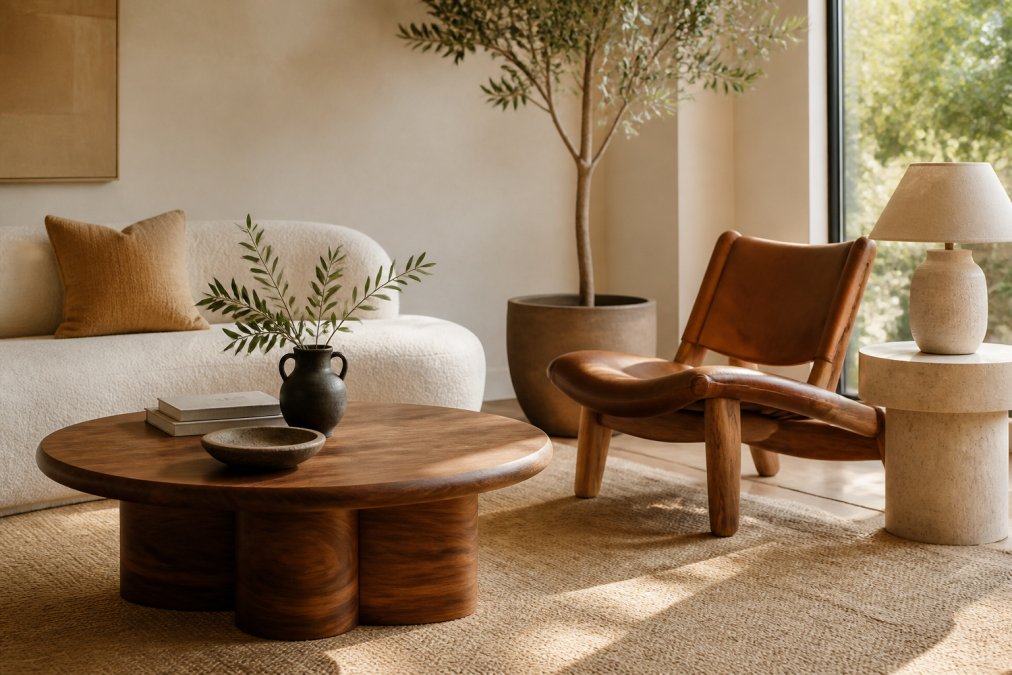
Coffee Tables and Centrepieces
The coffee table sets the tone. The Organic Walnut Coffee Table uses a sculptural organic base and a warm walnut finish, priced at $1,399.00. It suits a Japandi or Scandinavian scheme without dominating the room.

If you want stone presence, the Travertine Marble Coffee Table is handcrafted from genuine natural marble with a rounded silhouette, at $9,542.88. Every piece carries its own veining.

For a middle path, the Wabi-Sabi Travertine & Wood Round Coffee Table pairs genuine travertine with a solid wood base at $3,495.00.
| Piece | Material | Price | Best For |
|---|---|---|---|
| Organic Walnut Coffee Table | Walnut finish | $1,399.00 | Japandi and Scandinavian rooms |
| Wabi-Sabi Travertine & Wood Table | Travertine and solid wood | $3,495.00 | Great rooms and relaxed luxury |
| Walnut Round Coffee Table | Walnut | $3,499.00 | Contemporary lounges |
| Travertine Marble Coffee Table | Genuine marble | $9,542.88 | Statement centrepieces |
Lounge Chairs, Side Tables and Consoles
Seating should feel generous. The Nordic Leather Lounge Chair has a curved silhouette and deep cushioning at $3,455.00, and it works in a reading corner as well as a main seating group.

For accent surfaces, the Wabi-Sabi Travertine Pedestal Side Table brings an architectural pedestal form at $879.00. Entryways benefit from the Travertine Console Table, a genuine travertine piece at $6,699.89 with clean architectural lines.
Lighting and Finishing Touches
Lighting is where most rooms fall short. Overhead downlights flatten texture; layered warm light reveals it.
The Travertine Rechargeable Table Lamp offers three adjustable temperatures and no visible cord at $229.00. The Travertine Halo Table Lamp adds a floating shade for $199.00, while the Nordic Linen Table Lamp softens a console with a textured linen shade at $149.00.
How to Style an Organic Modern Living Room With Pieces You Already Own
You do not need to start from scratch. The fastest route is to keep your existing sofa and swap three things: the coffee table, the lighting and the textiles.
Work in this order:
- Remove anything glossy, chrome or heavily patterned from the main sightline
- Add one stone or raw wood surface as the anchor
- Layer two or three textiles in breathable fabrics such as linen or wool
- Introduce one sculptural light source at low height
- Add a single living element, a tree or large ceramic vessel
- Stop before the room feels curated rather than lived in
That last step is deliberate. Matchy-matchy sets read as a showroom. One inherited chair or an older rug keeps the space honest.
Best Organic Modern Furniture Brands: What to Vet Before You Buy
The best organic modern furniture brands are not the ones with the largest catalogues. They are the ones that name their materials, show real photography and explain how a piece is made. Because this category leans on stone, solid wood and natural fibre, the vetting process is closer to buying a building material than buying a sofa.
Ask four questions before ordering:
- Is the stone named specifically (travertine, Carrara marble, honed limestone), or described only as "stone-look"?
- Are dimensions, weight, finish and edge profile listed in full?
- Is the photography of the actual product, not a render or a stock image?
- Are care instructions supplied with the piece, and can the finish be repaired?
Eco-Certifications and Sustainable Sourcing
Certification language is where buyers get misled. A supplier can legitimately claim "sustainably sourced" without holding any third-party certification at all, because the phrase has no fixed legal definition in most furniture retail contexts. Here is what the common certifications actually cover, so you can ask for the right one:
- FSC (Forest Stewardship Council), applies to wood and wood-based products. FSC 100% means all fibre is from certified forests; FSC Mix allows a blend of certified, recycled and controlled wood (fsc.org). If a retailer sells walnut or oak and cannot state an FSC claim, ask why.
- PEFC (Programme for the Endorsement of Forest Certification), a separate international forest certification scheme, common in European supply chains. It is a legitimate alternative to FSC, not a lesser one.
- GREENGUARD Gold, tests for low chemical emissions from finished products, including formaldehyde and VOCs. Relevant for composite wood, adhesives and finishes in bedrooms and nurseries.
- OEKO-TEX Standard 100, applies to textiles. It certifies that a fabric has been tested for harmful substances. Useful for linen, wool and upholstery claims.
- Cradle to Cradle Certified, a broader material-health and circularity standard. Less common in furniture, but a strong signal when present.
What to look for beyond badges: named timber species, statements about reclaimed or reclaimed-look material, and transparency about where stone is quarried. If a retailer cannot tell you the species of wood, that is your answer.
A Quick Material Reality Check
Before you trust a listing, run these three checks:
- Weight. Genuine travertine and marble are heavy. A large coffee table under roughly 40 kg is a warning sign. Ask for the shipping weight.
- Veining continuity. Real stone veining continues across the edge and underside. Printed resin patterns often stop at the face.
- Wood end-grain. On solid walnut or oak, end-grain is visible at the ends of boards and looks like the same species. Veneer shows a thin layer over a different core.
These checks take two minutes and eliminate most of the mislabelled product in this category.
Caring for Natural Materials: Travertine, Walnut and Linen
Natural materials reward a small amount of routine. Travertine is porous, so blot spills immediately rather than wiping, and reseal stone surfaces periodically according to the supplier's guidance. Avoid acidic cleaners, which etch the surface.
Walnut needs less attention than people expect. Dust with a dry cloth, keep it out of direct sun to slow colour shift, and use a felt pad under anything ceramic. Linen covers should be vacuumed monthly and rotated so wear stays even.
Humidity is the quiet enemy. Rooms that swing between very dry and very damp cause solid timber to move, so keep indoor humidity reasonably stable across seasons.
Budget vs Investment Pieces: Where to Spend and Where to Save
Most organic modern content assumes an unlimited budget. In practice, the look is achievable at three distinct tiers, and knowing which tier each piece belongs to is what keeps a room from looking either cheap or over-stuffed.
The Three Tiers
Entry tier (roughly $100-$500 per piece). This is where you buy the layers: table lamps, ceramics, throws, cushions, small side tables, wall decor. These pieces carry the palette and the texture without carrying structural weight. A linen-shaded table lamp or a stoneware vase at this tier can shift a corner as effectively as a new sofa.
Mid tier (roughly $500-$3,500 per piece). This is where the anchor pieces live: a solid wood coffee table, a genuine travertine side table, a quality lounge chair. You are paying for real material and joinery, not for brand. This is the tier where most rooms should concentrate their budget.
Investment tier (roughly $3,500 and up). Statement stone tables, large consoles, handcrafted marble centrepieces. These are pieces you buy once and keep for a decade or more. They justify the price through material rarity, craftsmanship and repairability, not through trend relevance.
Where to Spend
Spend on the pieces you touch and look at daily: the coffee table, the main seating, the console in your entry. These define the room and they take the most wear. A solid walnut or genuine travertine anchor will still work if your design vision shifts mid-project; a strongly coloured upholstered piece often will not.
Spend on repairability. Solid wood can be sanded and refinished; genuine stone can be re-polished. A $3,000 table that lasts twenty years costs less per year than a $600 table replaced every three.
Where to Save
Save on the layers that change with the seasons. Cushions, throws, ceramics and small accessories carry the palette without carrying the price tag. A linen lamp at the entry tier can shift the mood of a corner as effectively as a new sofa.
Save on anything you cannot verify. If a listing will not name the stone or the wood species, do not pay mid-tier or investment-tier prices for it. You are paying for a look, not a material.
A Simple Sequencing Rule
For a full renovation, sequence the purchase around the anchor. Buy the coffee table or console first, live with it for a month, then add textiles and lighting. If your design vision shifts mid-project, a neutral stone or walnut centrepiece will still work; a strongly coloured upholstered piece often will not.
For a smaller refresh, invert the order: start with lighting and textiles at the entry tier, then upgrade the anchor piece when budget allows. The palette stays consistent either way, which is what makes the room read as organic modern rather than as a collection of unrelated purchases.
Conclusion
Furnishing an organic modern home is a sequencing problem, not a shopping problem. Get the anchor piece right, vet materials honestly, and let the softer layers follow.
Suemasue's Place curates furniture and décor built around natural materials and refined craftsmanship, from the Organic Walnut Coffee Table to travertine lighting that finishes a room properly. If you want pieces that hold their character for years rather than seasons, shop the collection at Suemasue's Place and start with the anchor.
Frequently Asked Questions
What is organic modern furniture?
Organic modern furniture blends clean, minimalist silhouettes with natural materials such as travertine, walnut, linen and stone. Instead of sharp geometric edges and synthetic finishes, you get rounded forms, tactile surfaces and warm neutral tones. The result is a room that feels calm and contemporary rather than cold or overly styled. Look for pieces with visible material character, like natural stone veining or wood grain, because those details are what separate genuine organic modern design from a generic minimalist look.
What materials should I look for when buying organic modern furniture?
Prioritise genuine natural materials over veneers and composites. Travertine and marble bring stone accents and one-of-a-kind veining, solid walnut and acacia wood add warmth, and linen upholstery keeps seating breathable. Check that stone pieces are described as genuine rather than travertine-inspired, and ask how wood is finished. Natural materials vary in colour and texture, and that variation is a feature, not a fault. It is also why two pieces of the same design will never look identical in your home.
Is the organic modern design trend still popular in 2026?
Yes, and it has shifted from trend to default. The style borrows from Japandi, Scandinavian and biophilic design, all of which emphasise warmth, natural textures and grounded forms rather than novelty. Because it is built on materials like travertine, raw wood and linen rather than a specific colour of the moment, pieces stay usable when palettes change. That longevity is why design-conscious homeowners are treating it as a long-term direction rather than a seasonal refresh.
How do I mix organic textures with modern furniture pieces I already own?
Start with what you have and add one or two natural anchor pieces rather than replacing everything. A sculptural travertine or walnut coffee table can sit alongside an existing sofa and immediately shift the room toward organic modern. Layer in textural contrast through linen cushions, a jute or wool rug, and a stone or wood side table. Keep your existing modern silhouettes, since the style depends on that tension between clean lines and natural material, and add soft pops of colour through ceramics or art instead of repainting.
How do I care for travertine and walnut furniture?
Travertine is porous, so blot spills immediately and reseal stone surfaces periodically according to the maker's guidance. Avoid acidic cleaners, which etch the surface, and use coasters under glasses. Walnut responds well to dusting with a soft dry cloth and an occasional application of furniture oil to prevent dryness. Keep both materials out of prolonged direct sunlight, since stone can discolour and wood can fade or crack. Linen upholstery should be vacuumed on a low setting and spot-cleaned rather than soaked.