

Table of Contents
- Start With the Organic Modern Color Palette
- Choose Organic Modern Furniture With Clean Lines and Natural Materials
- Use the 3-5-7 Rule in Decorating to Balance Scale and Visual Weight
- Layer Textures and Soft Fabrics to Warm Up the Room
- Plan Lighting and Window Treatments for a Cozy Atmosphere
- Organic Modern Living Room Ideas That Work in Real Homes
- Common Mistakes to Avoid When Styling an Organic Modern Living Room
- Conclusion: Build a Room That Feels Warm and Timeless
- Frequently Asked Questions
Last Updated: October 7, 2026
Start With the Organic Modern Color Palette
The organic modern living room starts with color, not furniture. Get the palette right and almost everything you place on top of it will work. Get it wrong and even beautiful pieces will fight each other.
The palette itself is narrow. Think creamy off-white, warm plaster, sand, mushroom, and clay. Then add earthy colors: walnut, oak, olive, and soft charcoal. Warm walls matter more here than white ones. A cool grey wall makes natural wood look orange by contrast. A warm off-white makes the same wood look rich.
Here is how we would build the palette in order:
- Base (60%): creamy off-white or warm plaster on walls and large upholstery
- Mid (30%): wood tones and natural finishes on tables, shelving, and frames
- Accent (10%): olive, rust, or black in small doses
That ratio is the whole trick. Most rooms that feel "off" are simply unbalanced, with too much accent and not enough base.
Choose Organic Modern Furniture With Clean Lines and Natural Materials
Organic modern furniture sits between two ideas: modern classic shapes and raw, natural materials. Clean lines keep it from feeling rustic. Organic elements keep it from feeling cold.
Start with scale, not style. Measure your seating area before you shop. A common pattern in well-proportioned rooms is a coffee table roughly two-thirds the length of the sofa.

For a standard 12 by 14 foot living room, a practical layout is:
- Sofa against the longest wall, leaving 14 to 18 inches behind it for airflow and curtain clearance
- Coffee table 16 to 18 inches from the sofa front, close enough to reach, far enough to pass
- Accent chair angled 30 to 45 degrees toward the sofa, not parallel to it
- At least 30 inches of walking space on the main path between seating and the next wall
In a small room under 150 square feet, choose one sculptural piece and keep everything else quiet. A curved lounge chair against a plain warm wall does more than five small accessories.
In a large room over 300 square feet, use a rug to define the seating zone. The rug should be large enough that all front legs of the furniture sit on it, usually a 9 by 12 or larger.
Look for pieces with simple silhouettes and honest materials. Our Organic Walnut Coffee Table is a good example of the balance. Pair it with a Nordic Leather Lounge Chair and you have the two anchor shapes most organic modern living rooms need.

| Piece | What to Look For | Why It Matters |
|---|---|---|
| Sofa | Low back, deep seat, linen or boucle | Sets the room's height line |
| Coffee table | Sculptural base, natural wood or stone | Anchors the seating group |
| Accent chair | Curved silhouette, warm upholstery | Breaks up straight edges |
| Shelving | Open, warm wood, simple frame | Adds vertical texture |
If you are working with a tight budget, prioritize the sofa and the rug first. Those two pieces set the scale and the color foundation. Save on side tables, lamps, and decor, which are easier to swap later.
Use the 3-5-7 Rule in Decorating to Balance Scale and Visual Weight
The 3-5-7 rule in decorating is a simple styling method: group objects in odd numbers, using three, five, or seven items, and vary their height and size within each group. Odd numbers feel natural to the eye, while even numbers tend to look arranged rather than collected.
Apply it on every surface. On a coffee table, three items is usually right: a stack of books, a sculptural object, and something living. On a console, five. On open shelving, seven across the whole unit.
The second half of the rule matters just as much. Vary the height. A group of three objects at the same height still looks flat.
Try this order:
- Place the tallest piece slightly off-center
- Add a medium piece beside it
- Finish with a low, wide piece in front
Layer Textures and Soft Fabrics to Warm Up the Room
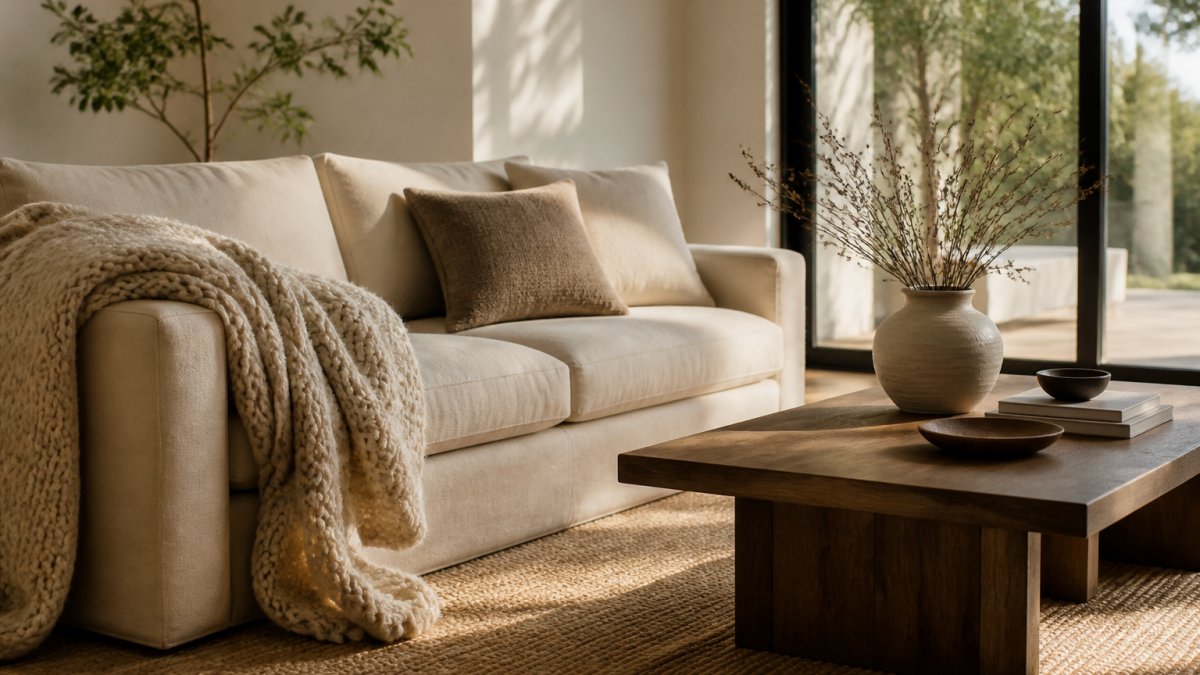
Texture is what separates a showroom from a home. A room can have perfect color and perfect furniture and still feel flat if every surface is smooth.
Layer soft fabrics against hard ones. Linen against stone. Wool against wood. A chunky throw over a leather chair. A woven jute rug under a smooth coffee table.
Plan Lighting and Window Treatments for a Cozy Atmosphere
Lighting is the step most people leave until last, and it shows. A room styled in daylight can turn harsh and flat after dark if the only light source is a ceiling fixture. The fix is a layered plan with specific placement and bulb choices.
Build three layers, and place each one with intent:
Organic Walnut Coffee Table | Japanese Minimalist Designer Center Table →
- Ambient: ceiling or recessed light, dimmed low. Aim for a dimmer on every ambient circuit. Without dimming, you lose the cozy evening mode that makes organic modern rooms feel warm.
- Task: a floor lamp beside a reading chair, with the shade at eye level when seated, usually 40 to 44 inches from the floor to the bottom of the shade. A table lamp on a side table works the same way.
- Accent: a small lamp on a console or shelf, or a picture light over art. Accent light should graze a surface, not flood the room.
Then watch your color temperature. Warm bulbs, around 2700K, suit organic modern rooms. Cool white bulbs make warm wood look grey and make linen look clinical. Keep every bulb in the room in the same range so the tones stay consistent.
A simple lighting plan for a 12 by 14 foot living room:
- One dimmable ambient source (ceiling fixture or four recessed cans on a dimmer)
- One floor lamp beside the main seating piece
- One table lamp on a console or side table
- One small accent light on shelving or over art
That is four sources for one room. Most practitioners find that three to five sources is the sweet spot, enough to layer, not so many that the room feels like a showroom.
Window treatments do the same job in daylight. Sheer linen curtains diffuse harsh sun and soften the room's edges. Hang them high, 2 to 4 inches below the ceiling or crown molding, and wide, so the panels stack outside the window frame when open. This makes windows look larger and lets more light in.
Organic Modern Living Room Ideas That Work in Real Homes
Real rooms have constraints: awkward corners, low ceilings, kids, and pets. Here are ideas that hold up under those conditions.
For a small room: choose one sculptural piece and keep everything else quiet. A curved lounge chair against a plain warm wall does more than five small accessories.
For a large room: use a big rug to define the seating zone. Rugs that are too small make large rooms feel disconnected.
For family homes: pick performance fabrics and stone or wood surfaces. Natural materials age better than high-gloss finishes, which show every scratch.
For renters: focus on lighting, textiles, and one or two movable accent pieces. None of these require a wall change.
The throughline in all four cases is the same. Spend on the pieces you touch and see every day, and save on the rest.
Common Mistakes to Avoid When Styling an Organic Modern Living Room
Most organic modern living rooms fail for one of four reasons. None of them are about taste.
- Too many cool greys. Grey walls plus grey upholstery plus grey rugs cancel out every warm wood tone in the room.
- All smooth surfaces. Without texture, the room reads as a furniture showroom rather than a home.
- Matching sets. Buying a full matching suite removes the collected, lived-in quality that defines the style. Mix at least two eras or finishes.
- Over-accessorizing. Every surface covered leaves the eye nowhere to rest. Empty space is part of the design.
A common mistake is treating organic modern as a shopping list rather than a balance. The style is defined by restraint, warm neutrals, and natural materials, so removing one item usually improves the room more than adding one.
Conclusion: Build a Room That Feels Warm and Timeless
The hard part of an organic modern living room is not finding pieces. It is knowing when to stop. Warm walls, natural materials, layered texture, and a lighting plan that works after dark will carry a room further than any single statement piece.
That is where we come in. At Suemasue's Place, our collection is built around refined craftsmanship and natural materials, from sculptural walnut tables to travertine and ceramic accents. Each piece is chosen to work with what you already own, not replace it.
Start with one anchor piece and build outward. Shop the Collection and create a living room that feels warm, collected, and unmistakably yours.
Frequently Asked Questions
Is organic modern timeless or trendy?
Organic modern leans timeless because its foundation is natural materials, neutral tones, and clean-lined furniture rather than a single seasonal trend. A solid walnut coffee table or a sculptural leather lounge chair stays relevant for decades, while trend-driven pieces date quickly. The style borrows from mid-century and Japandi design, both of which have held their appeal for generations. If you invest in quality craftsmanship and avoid loud patterns, your organic modern living room will still feel current in ten years.
What is the 3-5-7 rule in decorating?
The 3-5-7 rule in decorating is a guideline for grouping accessories in odd numbers: three small items, five medium items, or seven mixed pieces. Odd numbers create visual balance because the eye cannot pair them symmetrically, which feels more natural. On a coffee table, try three objects of varying heights, such as a ceramic vase, a stack of books, and a travertine bookend. On a console, group five or seven pieces in a triangle shape, keeping the tallest item off-center for a relaxed, organic feel.
How do you make an organic modern living room feel cozy?
Cozy comes from texture and light, not from clutter. Layer soft fabrics like linen, wool, and cotton in throws and cushions, and add a woven jute or wool rug underfoot. Choose warm bulbs around 2700K to 3000K for lamps and accent fixtures, and use dimmers so you can lower the light in the evening. Curtains in a creamy off-white soften window glare and frame the view. A leather lounge chair with deep cushioning also adds warmth and invites people to linger.
What colors and materials work best in an organic modern living room?
Stick to a palette of creamy off-white, warm beige, taupe, and muted earthy colors like clay, olive, and soft terracotta. For materials, choose solid wood with visible grain, genuine stone such as travertine or marble, linen, wool, jute, and matte ceramic. Metals should be brushed or aged rather than polished. A walnut coffee table, a travertine bookend, and a sculptural ceramic vase cover wood, stone, and ceramic in one grouping, which is the core material mix this style relies on.